ParlLawSpeech

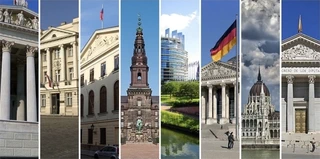 See parllawspeech.org for image sources
The ParlLawSpeech dataset offers 4.02 GB of data in total, including machine-readable full texts of 43,582 bills, 28,124 laws, and 3,092,431 plenary speeches from eight European parliaments covering more than two decades each.
ParlLawSpeech is meant to push the systematic analysis of European democracies with advanced text-as-data/NLP methods. Compared to the other excellent extant political science text corpora (cf. Sebők et al. 2025), it adds two key innovations. First, the bill and law corpora are are among the most encompassing full-text vectors of legal documents handled by parliaments. Second, we provide novel data linkage possibilities by offering a common identifier across bills, corresponding plenary speeches, and finally adopted laws- opening up new analytical opportunities to study the legislative process (basic ideas in the tutorial section).
This dataset is the result of the OPTED Work Package 5 (WP5) led by Sven-Oliver Proksch, Christian Rauh, and Miklós Sebők and funded by the European Union’s Horizon 2020 program (Grant agreement 951832). Our task was to develop different prototypes for improving access to linked parliamentary text data produced in European democracies.
This page provides a quick overview of the data structure to potential users. More detailed information is provided in the codebook shipped with the data repository that is permanently stored at GESIS.

I am a doctoral researcher in Political Science at the University of Cologne.
My research lies at the intersection of European politics, comparative politics, and political communication. One recurring focus of my research concerns how political actors and citizens respond to crises and institutional constraints in multilevel political systems, with a particular focus on Europe.
Substantively, my work examines crisis governance, political communication, and public attitudes toward democratic institutions. Methodologically, I combine theory-driven research with survey experiments, large-scale text data, and computational approaches to the study of political behavior and political discourse.
Please feel free to explore my work and get in touch.